Full house = full heart.
 |
| Little grandson came to visit! |

 |
| 6-week old bundle of sweetness |
 |
| My baby with his baby |
 |
| My first-born and first-time uncle with his little nephew |
Full house = full heart.
|
| Little grandson came to visit! |
|
| 6-week old bundle of sweetness |
|
| My baby with his baby |
|
| My first-born and first-time uncle with his little nephew |

On our return drive from Virginia, road weary from driving through pouring rain in the mountains and just sitting for a long time in the car, we crossed into Ohio and passed signs for the Bob Evans Farm. T said, “We have to stop.” He found IT.
Our stop wasn’t to get a bite to eat. It was to rile up our kids in the family chat.
The original Bob Evans Farm, Restaurant, Homestead, and Museum are in Rio (pronounced rye-oh) Grande, Ohio, just a couple miles off Route 35. The sun was setting, we got to the farm and snapped a few quick photos, hopped back in the car, all in the course of 20 minutes. And of course forwarded the photos to the kids…


Last weekend we did a two day, there and back, to Richmond, VA. After seven + hours of driving, we got to the Charlottesville exit, our butts were numb, and we decided to take a quick side trip to the University of Virginia to walk around the campus that Thomas Jefferson designed. The campus is quickly accessed off I-64. We drove past the football stadium, followed a loop around the campus and saw new buildings, nothing that looked like anything that Jefferson designed. Back to the football stadium parking lot, Google UVA campus map, and we found The Lawn's location. Time for a stroll to the original campus.
The Lawn at the University of Virginia is surrounded by residential and academic buildings and gardens. Its focal point is the Rotunda, the most recognizable symbol of the university and designed by Jefferson as the library, not a church as would have been found at the center of most American universities at the time.
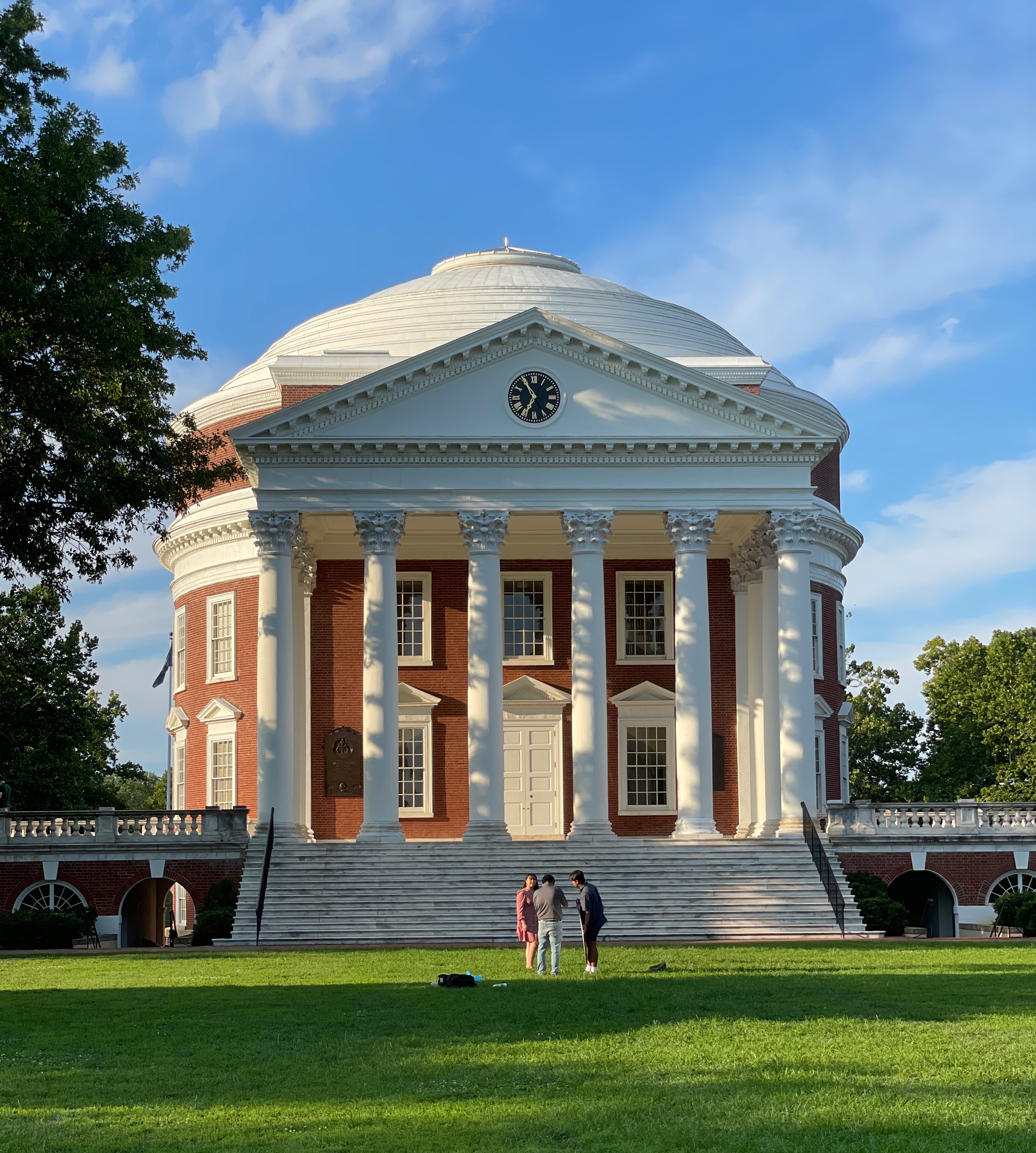
In his design, Jefferson broke the traditional English university quadrangle form that earlier colleges in the colonies had emulated. The open-ended layout of the Lawn was intended to encourage learning, living, dining, and playing all in one place and continues to facilitate Jefferson's vision of a mixed-use campus where students and faculty interact in varied settings on a daily basis. His concept was of a utopian "Academical Village" set apart from the world and focused on the teaching, learning, and cultivation of educated citizens.


Much to my English-major delight, we came across a historical marker noting the site of Edgar Allan Poe's room at UVA. He was one of University of Virginia’s earliest students and was there from February to December 1826, living at West Range, Number 13. A glass door allows visitors to see it furnished as a student room would have been in the early 19th century, and they can press a button to hear a recording about Poe's time here.


My mom would be 91 today. She left this earth in May 2020 from complications due to Alzheimer's. On her last birthday in 2019, all of my siblings were in town to celebrate and we all had a wonderful time. Mom was so happy to have all of her "babies" in one place. She laughed, she told stories, she fed cheese to my dogs. It was a good last birthday for her and for us.
Soon after this birthday celebration, the Alzheimer's really kicked in and changed Mom, COVID turned the world upside-down, we weren't allowed to come in to her care facility for a visit which greatly upset her (she hated talking through the windows because she couldn't hear the conversation), and then eventually she did not recognize any of us. It was sad to watch a woman who loved life so much pass from this world in this way but it was a comfort to know that she was free from this horrible disease.
Happy Birthday, Mom. Know that you are missed and loved.


modal verb – n. a verb (such as can, could, shall, should, ought to, will, or would) that is usually used with another verb to express ideas such as possibility, necessity, and permission.
These past tense modals are useful for expressing your present feelings about a past decision (or other action). Could have, would have, and should have are sometimes called “modals of lost opportunities.” They work like a grammatical time machine. The simple past just tells what happened. Past modals tell what could have, would have, and should have happened. These past modal verbs are all used hypothetically, to talk about things that really didn't happen in the past.
For me, this is a pet peeve. Seeing should of, would of, could of in print drives me up the wall.
Back in my school days, Grammar was a subject. Everyone learned parts of speech, sentence structure, verb tenses, punctuation, diagrammed sentences, and it built from elementary school through high school. As an English major in college, I took a Grammar class. Nowadays, Grammar is not taught as extensively as it was. So when people hear the contractions should've, would've, could've and don't understand - 've is a contraction of the helping verb "have," you get "of." And trying to explain this in a nutshell doesn't work because background knowledge isn't there.

We've gone from newlyweds to oldyweds,
From no kids to 4 kids to empty nesters (and our family has grown with our daughter-in-law, son-in-law, and grandson),
From one car to a parking lot driveway full of cars and now back to our own cars,
From late nights because we were young to late nights because we were parents (had four teenagers for a couple years) to now, "What's a late night?",
From our first home, an apartment on Shroyer Road, to the first house we bought on Greendale Drive, to our two houses after Greendale, to our downtown Dayton apartment (fulfilled our urban living dream), to our move to Columbus, to an upcoming new adventure...
And lots, lots, LOTS more!
Arm-in-arm, we're still walking through life, just like those twenty-somethings on their first steps down the aisle.

